
A child who has been in a Czech school for a few years often speaks better Czech than English at home. The parents, meanwhile, follow school life through translated messages and half-understood notices. When the entrance exams come, that gap becomes a practical problem: the exam is in Czech, but the decisions are made by the parents.
Two languages, two jobs
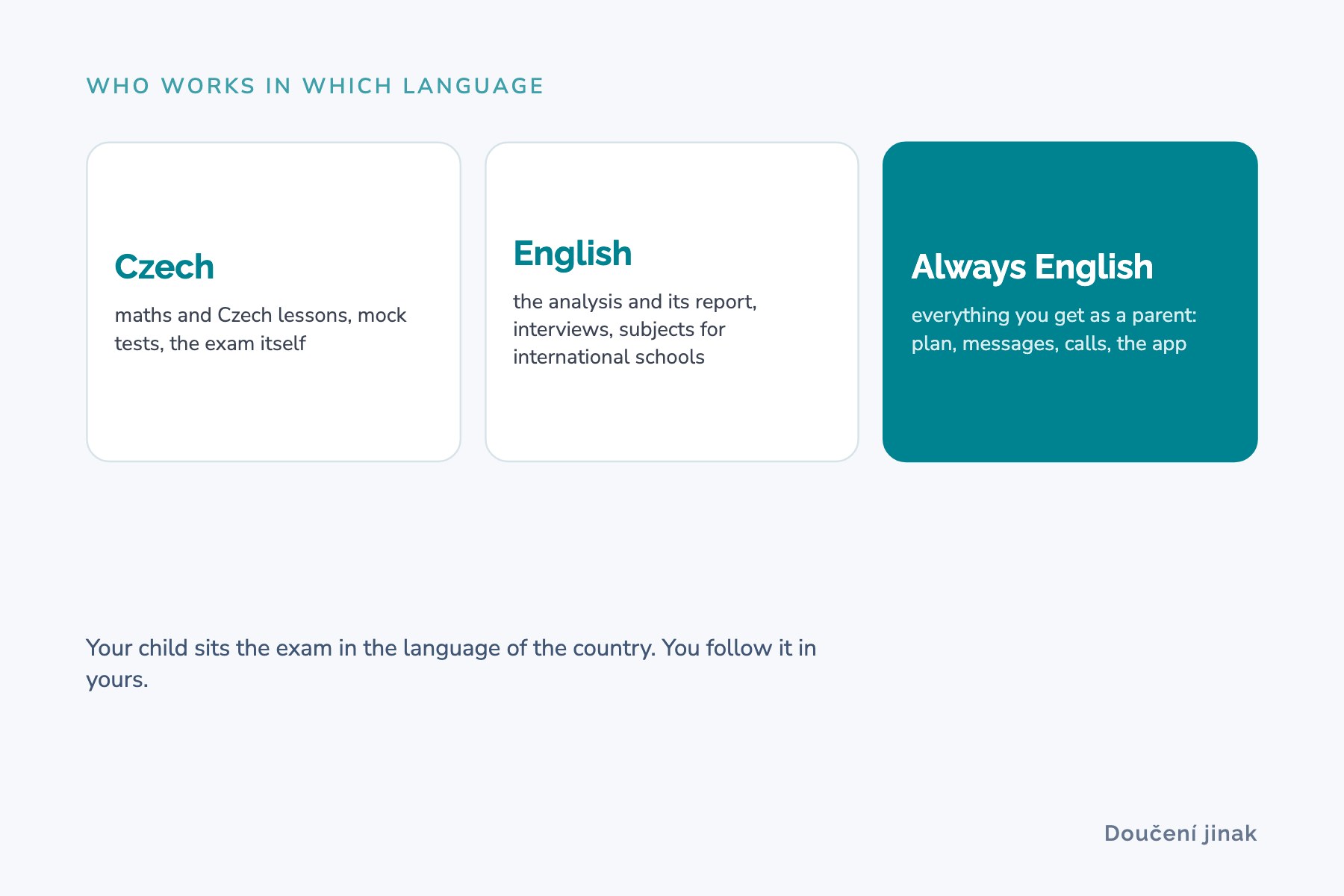
We split it deliberately. Czech and mathematics are taught in Czech, in the language of the exam, by Czech educational partners. English, interviews and subjects an international school will test are covered by our international team. Your child works in whichever language the task requires.
Everything that reaches you as a parent is in English: the analysis and its written report, the plan, messages and calls, and the app where you see the results. You are never asked to interpret a Czech document to find out how your child is doing.
Why not simply prepare in English
Because the exam is not. The maths test is written in Czech and the wording matters: a child who solves equations easily can still lose points on a word problem whose vocabulary they have never met. Preparing in Czech is not about the language for its own sake, it is about the format of the test.
What this looks like in practice
- The diagnosis runs in English with your child and with you, so nothing is lost in translation.
- The mock tests are in Czech, because the real ones are.
- You see points, chances and progress in the app in English.
- When the school waives the Czech test, we prepare the interview instead, which is spoken Czech, not written.
The result we aim for is simple. Your child sits an exam in the language of the country they live in, and you understand exactly where they stand.
 AuthorZdeněk VlčekZakladatel, analýza a metodika